
Bajaj Finance was the top loser in the Sensex pack, shedding over 2.5 per cent, followed by SBI, Bajaj Finserv, Tata Steel, Asian Paints and Axis Bank. NSE Nifty dipped 15.40 points to 15,763.05.

Omkeshwar Singh, head, Rank MF, a mutual fund investment platform, answers your queries.

Benchmark indices ended on a flat note on Thursday as fag-end selling wiped out intra-day gains amid weak global trends. The BSE benchmark Sensex slipped 8.03 points or 0.02 per cent to settle at 53,018.94. During the day, it had gained 350.57 points or 0.66 per cent to 53,377.54. Similarly, the broader NSE Nifty fell 18.85 points or 0.12 per cent to close at 15,780.25.

Tuesday's top gainers included SBI, UltraTech Cement, HDFC Bank, L&T, Bharti Airtel, Maruti Suzuki and Kotak Bank.

The bourse's valuations may get a boost, as it gets set for its OFS of about Rs 10,000 crore.

The action comes days after the CBI registered an FIR in the country's biggest alleged bank loan fraud case till date.

Anil Ambani had given a personal guarantee to the loans given by SBI to Reliance Communications and Reliance Infratel in August 2016.

Insurance behemoth LIC on Tuesday said it has garnered a little over Rs 5,627 crore from anchor investors led primarily by domestic institutions ahead of its mega initial public offering (IPO). Anchor Investors' (AIs) portion (5,92,96,853 equity shares) was subscribed at Rs 949 per equity share, the insurer said in an early morning filing to exchanges. Out of the allocation of about 5.9 crore shares to AIs, 4.2 crore shares (71.12 per cent) were allocated to 15 domestic mutual funds through 99 schemes, the filing said.

Equity benchmark Sensex rallied over 300 points in opening trade on Monday, tracking gains in index majors HDFC twins, SBI and ICICI Bank amid mixed cues from global markets.

Issues Rs 358 crore interim dividend, 1:10 bonus and 10:1 split

The recent run on the US-based Silicon Valley Bank (SVB) and the subsequent seizure of its assets by the regulators may have sparked a global wave of risk aversion, particularly for start-ups. However, the Indian banking sector is unlikely to be a victim of any contagion effects, said analysts. he bank, which played a big role in financing start-ups and technology players, faced stress after incurring huge losses on its holdings of US bonds, following the most-aggressive monetary tightening cycle by the Federal Reserve in around four decades.

HDFC Bank was the top loser in the Sensex pack, shedding over 3.5 per cent, followed by Bajaj Finance, L&T, HDFC, Bajaj Finserv, HDFC and Kotak Bank.
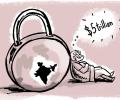
Chief Economic Advisor V Anantha Nageswaran on Thursday expressed hope that the economy will maintain the trend growth rate of 6.5 per cent and above for the rest of the years in the current decade. The economy will close the current fiscal logging in a growth of 6.5-7 per cent, he said, citing the projections of private sector analysts, Reserve Bank of India (RBI) and international agencies like OECD and the IMF. "This appears to be reasonable at this point in time although we will get the data on the fiscal second quarter in a few days, which will give more clarity on these numbers.

In the broader market, BSE midcap and BSE smallcap indices underperformed the larger counterparts and ended flat with a negative bias.
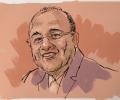
Having successfully executed the merger with parent HDFC, HDFC Bank's managing director and chief executive Sashidhar Jagdishan on Saturday said the country's largest lender aims to double every four years. In a letter to the over 4,000 employees from HDFC who joined the bank's rolls on Saturday, Jagdishan said the future is bright, and the work on realising the potential of the merger starts now. "The runway for financial services and mortgage, which are so underserved and under penetrated, is going to be very large. HDFC Bank - the combined entity - with a large and growing distribution and customer franchise, more than adequate capital, healthy asset quality and profitability, will be best positioned to capture growth.

Sliding for the fourth straight day, the BSE Sensex shed 152 points in choppy trade on Wednesday amid mixed global cues ahead of the US Federal Reserve's policy decision.

The Sensex was up 70 points and the Nifty was up 20 points led by SBI on robust Q2 earnings.
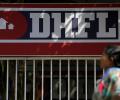
Piramal Enterprises' bid for debt-ridden DHFL received the most votes from lenders at the close of the voting process on Friday, sources said. Piramal Enterprises' bid received 94 per cent votes as compared to 45 per cent for the US-based Oaktree Capital. Voting was done on various parameters, including qualitative and quantitative.

Kaizad Bharucha, executive director of HDFC Bank, emerged the highest earning banker for 2021-22 (FY22). This was revealed in a remuneration assessment of the country's top bankers, according to annual reports. Bharucha, who oversees wholesale banking at HDFC Bank, received Rs 10.64 crore remuneration in FY22, mainly due to Rs 4.46 crore as performance bonus. Although earned between 2017-18 and 2020-21 (FY21), the bonus payout was partly paid in FY22.

Market regulator in talks with SBI Caps, UTI Infra for scrutiny and auction of properties.

Nikunj Saraf, Vice President Choice Wealth, answers your queries.
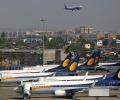
These are the four primary issues that have soured the relationship between SBI-led lenders and JKC and delayed the resumption of commercial flights by Jet Airways, once India's largest private airline, which went bankrupt in 2019. Over the past three years, the airline went through an insolvency process under which JKC's resolution plan was approved by a committee of creditors (lenders) and the National Company Law Tribunal (NCLT) in October 2020 and June 2021, respectively. But this didn't mean an end to the problems.

Bank of Baroda Q4 results: Key brokerages have raised their target prices on Bank of Baroda after the state-owned lender posted better-than-expected March quarter (Q4FY23) results. Analysts now see up to 29 per cent upside in the stock from a one-year perspective as they believe BoB is well-placed among the large public banks with nearly all key business metrics moving closer to the top-tier banks. Valuations, too, remain attractive despite steady strong quarterly performances.

The HPL board had reinstated its CDR committee to woo lenders.

Tata Steel was the top gainer in the Sensex pack, zooming 7.57 per cent, followed by Sun Pharma, IndusInd Bank, L&T, ITC and HCL Tech.

It is nearly after 13 years that a foreign brokerage has resumed holistic coverage on stocks of public sector banks (PSBs). To that extent, Morgan Stanley's report dated March 3, where the analysts have listed their order of preference for PSB stocks, is an indication that the state-owned banks may once again be attracting some interest, thanks to three back-to-back quarters of good results in FY21 so far. "State-owned banks' balance sheets have improved, and bad loans formation should moderate going forward," the analysts note and this is the key reason for them to relook at their stance on PSBs. While State Bank of India (SBI) remains their preferred pick, stocks of Bank of Baroda (BOB) and Punjab National Bank (PNB) have been upgraded from 'underweight' to 'equal-weight'. The brokerage maintains its underweight recommendation on Bank of India and Canara Bank.

The government on Thursday said it has no proposal to dilute its stake in the State Bank of India through either direct disinvestment or issuing of fresh capital in the market.

Market benchmark BSE Sensex rallied 635 points to 59,942 in the opening trade of the special Muhurat session on Monday to mark the beginning of Hindu Samvat year 2079. The 30-share index was trading higher by 635.12 points, or 1.07 per cent, at 59,942.27 in the first few minutes of trade. Similarly, the broader NSE Nifty surged 192.20 points or 1.09 per cent to 17,768.50.

Experts said the 20 per cent drop in the market poses a challenge for companies that have set the ball rolling on their IPO plans as valuations will now have to realign. This could entail more dilution or lowering of the issue size.

The SIP route suits the salaried class, by matching their income flows with investment frequency.
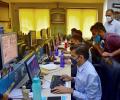
On the Sensex chart, NTPC, SBI, UltraTech Cement, ICICI Bank, Tata Steel, Bajaj Finserv and Bjaja Finance were among the major laggards, shedding as much as 1.63 per cent.

Low home loan rates by banks could put large players in an advantageous position over smaller non-bank players, believe analysts.

On the Sensex chart, SBI was the top gainer, rallying around 4 per cent, followed by Bharti Airtel, Reliance Industries, HDFC Bank, ITC, Axis Bank and NTPC. NSE Nifty advanced 78.70 points to a fresh closing peak of 14,563.45.

Omkeshwar Singh, Head, Rank MF, a mutual fund investment platform, answers your queries.

Omkeshwar Singh, head, Rank MF, a mutual fund investment platform, answers your queries.
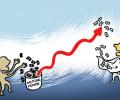
Omkeshwar Singh, Head, Rank MF, a mutual fund investment platform, answers your queries.

CII said working capital limit enhancement should be accompanied by relaxing norms related to collaterals.
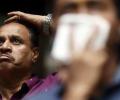
On the Sensex chart, HDFC, L&T, SBI, Axis Bank, Bajaj FinServ and HDFC Bank were major laggards - dropping up to 2.62 per cent. NSE Nifty closed with a loss of 164.85 points at 15,080.75.

Nikunj Saraf, Vice President Choice Wealth, answers your queries.

Bajaj Finance was the top gainer in the Sensex pack, surging around 5 per cent, followed by Bajaj Finserv, HDFC, Tech Mahindra, HDFC Bank, UltraTech Cement and Tata Steel. On the other hand, HUL, Nestle India, ICICI Bank, Axis Bank, SBI, TCS and ITC were among the laggards.
